

In the colored photo: Dorothy Young and Nancy Granfield. In the black and white photos: Dr. Max Grandfield, The Great Depression in California, Nancy Grandfield in the 1980s, Soldiers during World War 2, San Carlos Little League, The House of Nancy Grandfield.
On a bright morning in 2025, two remarkable women, Nancy Granfield and Dorothy Young, sat across from each other at San Carlos City Hall. Between them, 201 years of life. “I keep saying I’m a centurion. I’m not. I’m a centenarian” said Nancy, who turned 100 this year. Dorothy, 101 years old, added: “And we’re both members of an organization called the Village,” referring to Sequoia Village, a local nonprofit helping seniors age in place with dignity.
Their conversation as two San Carlos Centenarians, recorded as part of the San Carlos Centennial’s StoryCorps project:
Settling Down in San Carlos
Dorothy arrived in San Carlos in 1951 and has lived here for over 73 years. “When (my husband) came home from the Army, we got married in 1946 and were married for 75 years.” Born and raised in San Francisco, she and her husband were drawn to San Carlos by the promise of a warmer climate and better schools. “(After my husband returned from World War II), he worked for Price Waterhouse and traveled a lot,” Dorothy recalled. “Coming home to cold and foggy San Francisco wasn’t appealing. So we looked south.”
The couple first settled in the southwest corner of town, technically part of the Redwood City School District instead of San Carlos, but still the community felt just right. The neighborhood was friendly. The park was close by. It felt like a place to grow.
Nancy’s journey to San Carlos was guided by something even more personal: love at first sight. With a house. “I wanted a big, old house,” she said. “And there it was, sitting there waiting for me.” Built in 1931, Nancy’s home is now featured at the Museum of San Carlos History. “Every morning, I walk into the living room and say, ‘I just love you.’ And the sun comes in and it’s just a lovely house.”
Her home sits on a quirky one-block street called Vista, which had only three houses when she first moved in. “Everybody now who lives on Vista is 100 years old. We’re all ancient,” she laughed.
On Husbands and Homes
Both women have lived in their current homes for more than half a century: Dorothy for 57 years, Nancy for over 70.
Dorothy described her hillside home on Drake Court as “comfortable and easy to care for.” It’s the second home she and her husband purchased in San Carlos. After living 14 years in a smaller house nearby, they decided they needed more room. “We thought, well, let’s just get a little bigger, more roomy house,” she said. “So we moved up to Drake Court and just stayed there because we liked the house, we liked the neighborhood, we liked our neighbors. It was just so pleasant, and still is.”
Nancy’s home, on the other hand, is large and layered, with big bedrooms, a full attic, and what she affectionately calls the “lower mall”: a converted downstairs space with its own kitchen and dining room. “Everybody loved to come. It was a big house,” she recalled.
She remembers one Christmas season when a total of 136 people had visited her home. “People just came,” she said. “We had lots of room, in the kitchen, moving around, and lots of good food and lots of good wine.” Over the years, her home became a regular gathering place for holidays and church events. “I think it was fun,” she said. “And Max and I loved to entertain.”
Speaking about her late husband, Nancy replied, “He was the most wonderful man in the world. Everyone says so.” She added, “He was kind, honest, generous, and never said anything that could offend anyone, because he hardly said anything at all.” Max, a veterinarian, became San Carlos’s first house-call vet. “When he passed, over 250 people sent letters,” she said. “That’s the kind of man he was.”
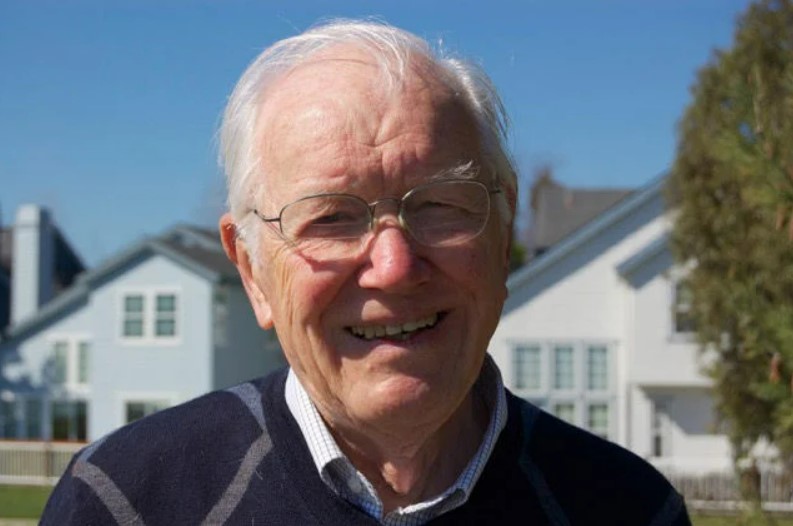
Dr. Max Grandfield, Nancy’s Husband, from the San Mateo Daily Journal Orbituary.
Dorothy reflected on the steadiness of her own 75-year marriage, noting that her husband never once raised his voice in anger. “That was just his disposition,” she said. “And neither did I, really.” While there were moments of quiet between them, she emphasized that their relationship was grounded in calm, kindness, and respect. “We laughed a lot and liked each other,” she said. “Our family has a sweetness about it. Even now, the kids always remember each other’s birthdays, and my birthday, and their children are all good friends, too. So it’s nice.”
Dorothy also credited their financial stability to the lessons they carried from the Great Depression: “We never had money problems, because we both grew up during the Depression. And we were very frugal. I was extremely careful about how I spent money,” she said. Dorothy handled the daily finances, while her husband later took care of investments once they were in a position to do so. Together, they sent all three children to college without the need for student loans. “They didn’t end up with any horrible debt, which so many young people do now.” Today, all three have gone on to successful careers.
Staying Home, With Help from the Village
Both women credit the Sequoia Village, a local nonprofit, with helping them stay in the homes they love. From transportation to minor repairs, the Village provides a vital safety net.
“When my kids asked me to stop driving in my 90s, I knew it was time,” said Dorothy. “Now, every Thursday a volunteer takes me to the beauty shop. My son picks me up and we spend the afternoon doing errands. It’s our day.”
Nancy leaned into the microphone and added, “They’ll do anything. I told them I needed a man in my life. I got one: his name is Bob. He’s my go-to guy. Fixes the fence, takes my cat to the vet. He’s family now.”
Wisdom from Centenarians
The interview closed with laughter, soap nostalgia (remember Lifebuoy?), remembering Sears Roebuck catalogs, and a recognition of how much has changed in a century. “We didn’t have Kleenex,” Nancy said. “And we wore silk stockings. Life is completely different now.”
“I will just throw this in, and it’s nothing. But it really, really concerns me to see when the kids are standing here on the corner after school’s out. And not one of them is talking to each other. They’re all like, I bet these damn things. And I just think that’s the saddest, saddest, saddest situation,” says Nancy.
When asked what advice they’d give their younger selves, Nancy answered without hesitation: “Wake up every morning expecting a miracle—and then get out of bed and claim it.”
Dorothy emphasized kindness and service: “Do something that’s helpful and meaningful. Volunteer. Care for others. That’s what stays with you.”
—
This StoryCorps interview was conducted at San Carlos City Hall on February 25, 2025, as part of the San Carlos Centennial Celebration. You may listen to the interview at StoryCorps Archive
Join us on July 24
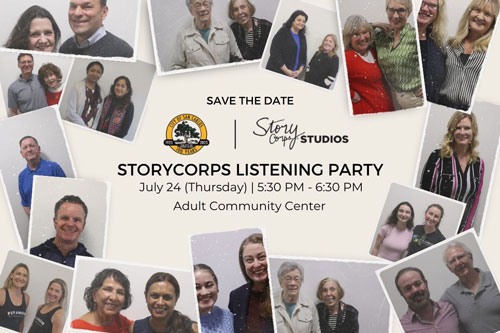
STORYCORPS LISTENING PARTY
July 24, Thursday | 5:30 – 6:30 PM | Adult Community Center
Join Parks & Recreation and the StoryCorps studio team on Thursday, July 24, for a behind-the-scenes look. You’ll learn more about the interview process, hear how StoryCorps creates and stores thousands of memories online and through the Library of Congress, and get a sneak peek at the animated audio cards created using choice clips from five of our San Carlos stories! RSVP online by July 20:
The Interview Transcript
Introduction
[Nancy]
Yes, good morning. My name is Nancy, Nancy Granfield. I’m 100 years old. I keep saying I’m a centurion. I’m not. I’m a centenarian.
And I haven’t a clue what today’s date is, and I don’t care. We are at the City Hall in San Carlos, California, where I live. And the name of my interview partner is Dorothy Young, which delights my heart.
I am not a related at all. We’re just both of us centurions. Right.
And that’s that’s about it.
[Dorothy]
Yes, my name is Dorothy Young. I’m 101. Today’s date is February 25th.
We’re at the San Carlos City Hall. And the name of my interview partner is Nancy Grandfield. And we’re both members of an organization called the Villagers.
[Nancy]
Yes.
How long have you been in San Carlos? Why did you move here?
[Interviewer]
We’re going to go ahead and start with the first question, which is going to be how long have you both lived in San Carlos approximately? Nancy, if you want to start.
[Nancy]
No, I’d rather Dorothy started because I have to figure out.
[Dorothy]
I have lived in San Carlos for 73 years, except for two years when my husband was transferred to England. And we just left in June of 1965 and came home in August 1967. We rented a house over there and our older son went to the American School in London because he was a junior and he had had a freshman and sophomore year at San Carlos High School.
So we came back and sold our – we had rented out our original house. And then we sold that and moved to a larger one. And we have lived there for 57 years.
[Nancy]
Okay. I have. I don’t know exactly when I moved to San Carlos. But my son, Chris tells me, went to Arundel. So he would have been how old?
[Interviewer]
Six.
[Nancy]
Six. Okay. So he was born in 1947.
So how old would he have been when he was six? Forty-seven and plus six.
[Interviewer]
That’s okay.
That’s when I, that’s when I moved to San Carlos.
[Interviewer]
And why did you all move here?
[Nancy]
Why did I move here? I moved here because I liked the house. I bought the house. I wanted a big house and I wanted a big old house. And there was one sitting right there waiting for me. So we had lived for eight years in Hillsdale and San Mateo and then moved to San Carlos.
[Dorothy]
My husband and I were both natives of San Francisco. And so when he came home from the army, when he had been in World War II, we got married. And in 1946, and we were married for 75 years, and then he passed away.
He worked for Price Waterhouse as an accountant and an auditor. And because he traveled to Sacramento or Texas, he said coming home to San Francisco to the cold and fog was not so great. So why didn’t we look for a house in a better climate?
So we settled on San Carlos because we heard that the schools were really good. And ironically, the little corner of San Carlos that we lived in was in the southwest corner, but it was in the Redwood City School District. But that didn’t change our mind.
And our children were fine in the Redwood City School District. So that’s why we found a house in San Carlos and have loved it.
What are your favorite memories of living in San Carlos?
[Interviewer]
And what are some of your favorite memories of living here?
[Dorothy]
Well, we liked the park. Our children played in Burton Park, and we had good neighbors. And all the children went to the same school in Redwood City.
It was Clifford School, which was really up in the hills near Palomar Park. And then my husband and I started folk dancing. And we folk danced for 50-some odd years.
[Interviewer]
Where did you folk dance?
[Dorothy]
Well, it was a Redwood City folk dance group. And because we knew the parents of our children, so our social activities were more to Redwood City than San Carlos. But it was just a beautiful little town.
So thank you.
[Nancy]
Well, we have a strangest… I’m looking at, as I sit here, at this city map of San Carlos, which is behind Dorothy. Yes.
Oh, yes. I have to lean back because it feels comfortable. And our block is…
Vista is only one block long. So we don’t have… And it’s on a curve.
If I look at this, it goes… It’s on an S. So actually, I don’t…
We don’t have a neighborhood. Everybody now who lives on Vista is 100 years old. We’re all ancient.
But we didn’t have a neighborhood where if you live on a curve and you’re only one block long, you’re not going to be running into play and kick the can and hide and go seek and things like that with your children playing together. There weren’t any children. And if there were, I didn’t know them because they lived around the curve.
So none of our houses face the street. So I… Okay, I’ve lived there, what, 70 years.
I’ve been in my neighbor’s house about three times in 70 years. I know that we say, hello. Her name is Carol.
She’s a lovely woman. And she didn’t have any children. So I didn’t have anything to say to Carol much.
Alan and Judy lived next door the other way. And their house faces an entirely different direction. So we…
It’s a very odd configuration, our street, our Vista. So we don’t… We didn’t have the, like your children, playing games and doing things.
And I’ve been in… I bet I’ve been in Judy and Alan’s house maybe four times in 70 years. We say hello and we do things.
We’re compatible. We’re fun. But it’s just like, it’s not a San Carlos neighborhood.
It’s very unique. And what I’ve discovered myself, I know every dog in San Carlos because everybody loves to cut from San Carlos Avenue to Cedar. They cut, they use my pluck to cut through and they walk their dogs.
So I see people walking up and down that’s past my house all the time, but they’re using it as a shortcut to get over to Cedar. So it’s not a neighborhood as one would think of a San Carlos neighborhood.
How was it like, raising kids in San Carlos?
[Interviewer]
And then you, it seems like you both raised kids here. Is that right? What was that like, raising kids in San Carlos?
[Nancy]
Well, not only…
I, we, my son went to Arundel and I, my daughter went to St. Matthew’s Episcopal Day School. And so she wasn’t in the neighborhood. She didn’t have neighborhood children.
We knew those kids that went to school down in San Mateo. And my son was, what he did was he loved track and cross country. And so he, his affiliations were through the, the track at, at Carlmont.
And that was, that’s how their acquaintances were supporters, sporting acquaintances.
[Interviewer]
I am going to interject. With Clifford and Arundel, did any of them go to San Carlos High?
[Dorothy]
Yes. My son, actually all three of our children did. By then we had moved from our first house, which was in the Redwood City School District, and we had moved to where the San Carlos School District was.
So all three of our children well, our son, our older son only went junior and senior high school. And because he’d had the two years in London. And then our second son went to a Tierra Linda Junior High, because he was 11 years when he started.
And then our daughter went six months to the Redwood City School District, and then we moved to San Carlos. So he, she went to Heather Elementary, and then, yeah, she did go to Tierra Linda, and then graduated from San Carlos High.
[Nancy]
Where’s Tierra Linda? I forget.
[Interviewer]
It’s on Alameda, across the street from Carlmont High School. And that one closed.
[Nancy]
Oh yeah, yeah, yeah.
[Interviewer]
And then reopened. So if you all remember that timing, and I don’t, I think one of your children went to San Carlos High when it closed.
[Nancy]
Well, actually I was wrong. He didn’t. He went to Carlmont.
They both went to Carlmont. But I think they must have gone to Tierra Linda.
[Interviewer]
And what did your kids, like, enjoy doing growing up? You said your son ran track, right Nancy?
[Dorothy]
Yeah.
[Nancy]
And where were you?
[Dorothy]
Well, our older son was in Little League in Redwood City again, because that’s where most of the children were from. And our son in San Carlos, the second son, was in soccer and track, cross country. And then our daughter, I don’t know that she was in any kind of sports in San Carlos.
So.
[Nancy]
Yeah, I’m not, this isn’t a good, good, I’m not a good interviewer for San Carlos schools, because Judy’s, all of her, her activities were around St. Matthew’s. And, and yeah, and my son, I tell you, funny, we live in this little one block long street, I told you, and on the corner, three houses from me, is Mr. Trask, and Mr. Trask taught at Carlmont High School.
And so my kids just thought it was really exciting to live three houses from Mr. Trask. And actually, last year, all of our, their friends come home and visit from time to time. And they all go ahead down and see Mr. Trask. And Mr. Trask is so pleased to know that his, his students of how many, 50, 60 years ago, are coming to say thank you and hi, Mr. Trask. So.
[Dorothy]
So isn’t that fun to live?
[Nancy]
That’s kind of interesting.
[Interviewer]
That’s so sweet. So would they, would they ever go by and say hi to him, like on the weekends or anything like that?
[Nancy]
Oh no, no, no, just when they come home. I, you haven’t asked this question, but I live alone, and one of my, my, my son lives in Studio City, and my daughter lives in Portland, so I, I don’t see them very often.
And so they, they have lives of their own up there and down there. They come and check in on me, and, but that, that’s, they’re, they’re not affiliated here with San Carlos anymore. When they went to, off to college, that I said bye-bye to my children.
No, I mean, not, not in a loving, I mean, loving, loving, lovingly, lovingly living there. We’re very, very close family, but they, they weren’t. Geographically, we’ve never been together.
[Interviewer]
So can I ask you, do you both still live in the houses? It seems like you both lived in the houses that you live in now for a long time, is that right?
[Dorothy]
Yes.
What do you love about your house in San Carlos?
[Interviewer]
And so why did you choose to stay in this same house for so long? What do you love about your house?
[Dorothy]
Well, our first house in San Carlos was actually our second house. We had been able to buy a house or put a down payment on a house in San Francisco that we lived in for four years. And then because my husband thought we could do better weather-wise, we moved to San Carlos and stayed there in that house for 14 years, and then two years after that in England.
So then when we came home, that house was a little small, although my older son had started college. But, but we thought, well, let’s just get a little bigger, more roomy house. So we moved up to Drake Court and just stayed there because we liked the house, we liked the neighborhood, we liked our neighbors.
It was just so pleasant and still is.
[Interview]
Can you describe your house? Like what does it look like? What does the yard look like?
[Dorothy]
We’re on a hill. Our house itself is level and then the garage is on the lower side. So we have a deck in the back because the hill comes down.
Apparently, they graded pads for houses to build on. And it’s just really comfortable. It’s three bedrooms plus a family room.
And then we finished a room downstairs for my second son. And then my dad came to live with us in 1974 and he lived with us for 10 years. So we gave him the upstairs bedroom and our second son lived in the downstairs room, which was fine with him.
So it’s just been a very comfortable house and easy to take care of. So now I have a gardener who comes once a month. But my husband was the gardener and we always had beautiful flowers out on the deck.
And now I have to get out there and water the few that are left.
[Interviewer]
And Nancy, for you, can you tell us about your house and why you decided to stay there for so long?
[Nancy]
Well, as I said, the reason I’m in San Carlos was because of the house. I just fell in love with the house.
Every single morning of this day, I go out in my living room and I just love you. I just love you. And the sun comes in and it’s just a lovely house.
It was built in 1931 and there, as I said, I guess to Dorothy earlier, that on Vista at that time, there was only three houses. And you can go to the San Carlos Museum and see my house. It’s a great big house.
And it’s got an attic, a full attic. It has a first story and then it has an underneath story because I don’t, we call it the lower mall rather than a basement. The people we bought it from had recently remarried and had three sons.
So they built, literally converted the whole garage and all of those, that area into another house for the boys. So I have two kitchens and three bathrooms and two dining rooms and two of everything for them. And all the doors all have locks on them to keep the children out.
But I just rattle, I use every single space of that house. I was saying that my friends, the editorial, we worry about you, and we do this. And we are so concerned that my computer room is downstairs. And they don’t like me going up and downstairs.
But when you’re old and you’re cautious, I’m a lot more cautious hanging on, which the village did for me. Put a great railing along, so I have that to protect me. And I’m very careful going up and downstairs.
And I take good care of myself, so it isn’t like I’m racing up and down like people run up and down, like you did. Both North and I said, as we saw you running up at those stairs, look at the ease and the speed with which you go up there. I think, well, let’s see.
I ponder before I go. But I do just love my house. And it has great big rooms, big bedrooms, and big closets, and lots of places for linens and stuff.
It’s just a great house. And there’s why I love the village there. Their concept is to help elderly stay in their homes if they want to.
They don’t have to go to assisted living, or no matter how nice it is. I can stay there the rest of my life. And that’s why it’s a-
[Interviewer]
Talk about the dairy farm discovery you had at the museum.
[Nancy]
Yeah. They’ll come and paint my porch. They’ll do anything.
They’ll do anything. They give us a ride to this interview.
[Interviewer]
Was there a dairy farm? Was there a dairy farm? Is there something about a dairy farm?
[Nancy]
It was. There was a dairy, because we used to find milk bottles from time to time in the soil. But it had beautiful, beautiful landscaping.
But I lost during the drought. Oh, I had the most gorgeous live oak tree in my front yard. And when was it?
We had that bugaboo a few years ago, and it killed my tree. And I had a beautiful yard. And now it isn’t beautiful anymore.
The drought and the PG&E between cutting down the trees and doing the things that they’re doing, I stand there and look at it and apologize and tell it, I’m sorry that it doesn’t look like it did. But I do love my house.
[Interviewer]
I’m curious if either of you have any favorite memories surrounding your house that come up for you? Maybe any big parties you had, or maybe memories on the deck, or anything like that to help us paint a picture of what your lives looked like in the home.
[Dorothy]
Well, my husband’s birthday was September 4th. My niece’s birthday was September 4th. Our son’s birthday was September 2nd.
So we always had a birthday party for all three out on our deck.
[Nancy]
And my husband’s birthday is September 4th. You didn’t invite me to your party.
But isn’t that interesting? All the dates have to be September 4th.
[Interviewer]
Mine’s September 5th, by the way.
[Dorothy]
My husband had his 100th birthday, too, in 2021. And then he passed away about three months later. But he was in good health just about till the end, and certainly mentally fine.
So that’s a big thing, I think.
[Interviewer]
What did that look like, all of this, celebrating so many birthdays at once? Were there three cakes?
[Dorothy]
No, I think, but mostly we just barbecued. And then everybody came. I mean, my niece’s children, and their children, and our children, our son and our daughter, and, of course, our regular son, and his wife.
So it was always a good-sized party. And it was fun. Everybody passed around funny cards.
And our family has a sweetness about it. So even now, when the kids always remember each other’s birthdays, and my birthday, and their children are all good friends, too. So it’s nice.
[Interviewer]
Nancy, any favorite memories from your house?
[Nancy]
Oh, hundreds of years and years of memories. Yes, everybody loved to come. It was a big house.
And I could say it had lots of space. It has a big deck on the back. And so I’m very active over the years in the church.
And we would have, oh, one Christmas, I sat there, and I counted. I said, 136 people have been in this house over the holidays. People just came, because we had lots of room, and in the kitchen, and moving around, and lots of good food, and lots of good wine.
And so people liked to come to my house. I think it was fun. And Max and I loved to entertain.
About your husbands?
][Nancy]
And can I tell you about my husband?
[Interviewer]
Please tell me about your husband, yes.
[Nancy]
Right now, I’ll tell you, because he’s the absolutely most wonderful man in the entire world. Everybody says so. So when everybody says how wonderful you are, you know you’ve got to be pretty special.
And he was a very, very kind, generous, honest, all the attributes he had. But he was very quiet, because I’m not. And he would just be the perfect host.
He would walk around talking about it. And then he would pour the wine, and just never say anything. And I always said, well, the reason you never offend anybody is because you never say anything.
And he didn’t. Everybody just loved him. And he 2017.
He’s been gone. No, that’s not true. He’s been, I guess he’s been gone about five years.
But I’m just going to interject this, and then I’m going to be quiet. I just want to think he was a veterinarian. And when he died, he got over 250 letters from clients saying how wonderful it had made their lives.
And he became, the last, say, 10 years of his life, he became the first house call veterinarian in San Carlos and in the Bay Area. So he would go into people’s houses, and they all became very attached to him. So that was why people liked to come to our house, was because the house was big.
And the food was good, and Max was there.
[Interviewer]
And you were there, too. I’m sure they came for you as well, Nancy.
[Nancy]
Well, yeah. But I’m sure Dorothy said the reason that we’re living 100 is because we’ve lived happy, wonderful, blessed lives. That’s certainly in my case.
I think in my case. And Dorothy, tell them the story about your husband when he asked you to marry him.
[Dorothy]
Pardon?
[Nancy]
The story you told me in the house. Oh, we were engaged. And before he went into the Army.
10 years apart. No.
[Dorothy]
How far apart were you?
[Nancy]
He was only 2 and 1⁄2 years older. But he was a student at Cal, at Berkeley. And then he was a senior.
And they let him finish before he had to go in the Army, which was really a good thing. And then we got married two months after he got home, 2 and 1⁄2 years later. And in the meantime, he had said, marry me, and you’ll always be young.
So it was young, or still is, for 75 years. So our son sent back to Washington for something, for having a acknowledgment letter from the President of the United States congratulating us on 75 years of marriage. Of course, you know, it said Joe Biden, but we know that he didn’t probably sign it himself.
[Dorothy]
Yes, he did.
[Nancy]
But it was nice.
[Dorothy]
Of course, he did.
[Nancy]
You think?
[Dorothy]
He signed my birthday. Did he sign your birthday?
[Dorothy]
No, my son sent one for his dad for his 100th birthday. And I forget who signed. I think, I don’t remember.
21, it must have been Trump.
[Interviewer]
So you got a letter from Joe Biden when you turned 100, Nancy? Did what? You got a letter from Joe Biden when you turned 100?
[Nancy]
Of course, yes.
[Interviewer]
When did they take that?
[Dorothy]
Last year, yeah. Well, I’m Dorothy. Of course he signed it.
[Interviewer]
Oh, OK.
The secret to reaching 100 years old?
[Interviewer]
Yeah, so you guys talked about this a little bit, that you think the secret to being 100 or over 100 is having a happy life. Can you guys speak a little more about that?
[Dorothy]
My husband, in 75 years, did not raise his voice once in anger. And I think that was his disposition. And neither did I, really.
There were little times when we didn’t talk to each other. But on the whole, his disposition was very even and kind. And I think our children just learned that from him just by example.
So I would say we had a really good marriage. He had a good sense of humor. And we laughed a lot and liked each other.
So we never had money problems, because we both grew up during the Depression. And we were very frugal. And so I was extremely careful about how I spent money.
And I took care of all the finances, as far as writing checks and balancing the bank statement. He took care of the investments and that sort of thing when we were able to, finally. Because we put three children through college, and they didn’t end up with any horrible debt, which so many young people do now.
And they’ve all been successful in their careers. And so I think we didn’t have a lot of emotional stress. And I think that helped.
[Nancy]
That helps. Yeah, we didn’t have any emotional stress. The only time we ever had an argument was over money.
I wouldn’t want to give it away to Tom Dooley or somebody. And Max would say, well, he’s not on the list. And my husband, well, we both grew up in Kansas.
I lived across the street from him when he was two years old. So I always said he had no excuse for what he got himself into, because he had known me all those years. And his parents were farmers.
And those days, farmers, well, of course, they’ve always had problems. But if they’d have a good crop that year, they would bury the earnings, literally, in a jar in the ground for the next year when the crops weren’t that good. And so, how did we get off on that?
What was the question?
[Interviewer]
Just asking what you think the secret is to being married.
[Nancy]
Oh, yeah, yeah. So I think that we both came from a background, as you say. And we were married 74 years.
Yeah, you pay attention. You count your blessings. And it’s an entirely, entirely different life now that I see these young people living how I grew up.
[Interviewer]
How is it different? Can you speak about it? I know it’s very different, but.
[Nancy]
Oh, completely different, completely different. Blowing my nose on Kleenex. I knew the years when we didn’t have Kleenex.
We didn’t have Kleenex, and we wore silk stockings. Yes, silk stockings. Oh, you think of these things that are.
Oh, the other day, I was thinking of Lifebuoys. So do you remember Lifebuoys? I do.
Somebody said, what? And I said, yeah, it was orange. I mean, the products, our lives are entirely different.
I will just throw this in, and it’s nothing. But it really, really concerns me to see when the kids are standing here on the corner after school’s out. And they’re all, not one of them is talking to each other.
They’re all like, I bet these damn things. And I just think that’s the saddest, saddest, saddest situation.
[Dorothy]
One thing, for my 100th birthday, friends gave me magazines that were printed in January 1924.
And the ads were really interesting. And unfortunately, the worst one was an ad for Colt guns.
[Nancy]
For what?
[Dorothy]
Colt guns. I mean, 100 years ago, they were advertising, selling you cannot live without a gun. And I thought, how disgusting that is, and how little we’ve learned about guns.
So anyway, and someone, actually, they gave me, I have two 100-year coins, dollars, silver dollars, that are both 1924. I guess you can buy them online. So I wish I could make a necklace or something.
[Interviewer]
You can. I’m sure there’s a way.
[Dorothy]
And probably. So that was really nice. But the magazines, one was a Saturday evening post, which has been around for a long time.
And so it was really fun. Everybody liked looking through them, mostly at the ads, because some of them are still around. And it was just interesting.
[Nancy]
Remember the Sears Roebuck? You could sit at the Sears Roebuck catalog. You could spend a whole year looking at that.
About the Sequoia Villagers?
[Interviewer]
Nancy, you talked about this a little bit. But I would love for you all to talk about the village. Is that the full name? The Sequoia Villagers, and just what that’s meant to you all, to be able to stay in your homes, and kind of what it looks like for volunteers, just kind of some examples of how they’ve helped you all be able to stay in your homes.
[Nancy]
You can talk about the villagers. They’re there. They’re a lifeline.
[Dorothy]
Well, when my children decided that it would be a good idea that we didn’t drive anymore, and we were both in our 90s, and they talked about how easy it was to step on the gas instead of the brake. And so we thought, if it disturbs them that much, we really should just give up driving. So a friend of my daughter’s mother belonged to the villagers.
And so she gave me the phone number. And someone came out and explained all about how it worked and what we could do. And so it’s really been wonderful to be able to request a ride to a doctor’s appointment or to get your hair done every week, the way my daughter laughs at me.
And so what happens on Thursday, a villager picks me up and drops me off at the beauty shop. And then my son, who lives, my second son, who lives in Half Moon Bay, comes over and picks me up at the beauty shop, and then takes me shopping, grocery shopping, or to the library, or CVS. And then when we first joined.
And someone came in from the villages and put safe bars in the shower and in the bathroom and they put in fire alarms and then just generally inspected everything for safety and I mean that’s the primary thing I think for older people is that there’s a safe environment and so it’s been wonderful. My son has is retired but he has his own things to do and but Thursday’s our day and so it really works out wonderfully.
[interviewer]
It sounds like a beautiful Thursday.
[Nancy]
It is. They not only put in the fire alarms but they come by every once in a while and change the batteries. They’re on top of things and it’s interesting thinking about it.
When I first heard about it was, I don’t know how, but our first, my husband and I walked down, we live nearby, and it was in the room in the library and we sat there in the library and this person stood up and told us about the concept and so forth and the first thing they said of course was picking you up and taking you places but what the, for example, I decided I needed a man in my life. All right? And so I called up the villagers and I said I want a man and my gosh I’ve got one.
His name is Bob DeMarco and he’s adorable and he’s my man and I call him up and I say hey Bob, my fence is falling down, who shall I get? Shall I get a new fence or shall I do something? I need a male mind at work and I don’t have one and I think they’re very special.
And so he, all I have to do, without a moment I just dial a phone and he’s there. He comes over, he took my cat to the vet and he, you know, just stuff like that. That is more than being like Chris, you’re wonderful, taking around and having transportation because they’ll do anything.
[Interviewer]
Do you all ever use the villagers for the social aspects? Like they do trips to museums and they have socials?
[Nancy]
They do, they have wonderful social things and I, in my 100 years, have decided long ago that I didn’t want to go to any of them. So I don’t go but I know people who do and they love it so there you go.
[Dorothy]
Well I do, I like the, I do go on some of them. I’ve been to the Hiller Museum and I’ve been to the San Carlos Museum and, but my problem now is I feel unsteady when I’m in a group of people. I’m afraid somebody’s going to back into me or it’s, it’s just not that comfortable. But I do like the social events that they have at the Senior Center.
They’re very nice.
[Nancy]
They’re fun.
[Dorothy]
And so I go to those but not on any trips anymore.
It’s just not comfortable.
Advice to young people today?
[Interviewer]
Well we’re right up a little bit over 40 minutes now. So if there’s any final words you all would like to say before we stop or anything you’d like to say to each other, any questions you have to kind of wrap us up. I would love for you to also to give me any advice if you were younger self to yourself and to me what you would do.
I think that’s a great final question. Just what would you say to your younger self? What advice would you give to your younger self?
[Nancy]
I don’t understand what a younger self is.
[Interviewer]
Just or to me or to Chris. What advice would you give us?
[Nancy]
It helps to wake up every morning breathing. No, seriously. Yes, I have, for one thing, I have a very positive attitude.
I wake up every morning expecting a miracle and then I get out of bed and claim it. It’s out there. And I pay attention.
I show up because good stuff’s out there. And then I have, my heart overflows with gratitude. I just think gratitude is huge.
Every year I pick a word. Every year I pick a word. And gratitude was one of my words over the years.
But this year it’s called acceptance. And I don’t like it very well. I’m thinking of turning in that word and getting another one.
But I think having a positive attitude and being aware of beauty and all the good stuff around you is, it helps, as I jokingly said, it helps to breathe. But I think, I feel people are very capable of living wonderful lives. It’s a matter of choice.
It’s a matter of choice and I choose. I choose the good. I choose that and it works.
[Interviewer]
That’s wonderful. Dorothy?
[Dorothy]
I always did some sort of volunteering after our children were gone. And I worked for Second Harvest for a while. I worked at Filoli for a while.
[Nancy]
You knew, maybe knew Max. Pardon me? Did you know Max Grandfield at Filoli?
[Dorothy]
No. Oh, I’m sorry. I got so excited to hear you say Filoli.
[Interviewer]
What’s Filoli?
[Dorothy]
It’s our local stately home. It’s over in, off Woodside, or off Kenyatta Road.
Out, what, 92, sort of, out that way. And they have beautiful gardens. And they have quite a large membership, volunteer membership.
So I was on the mailing committee. And then my husband was on the garden committee. And so that’s what we, you know, where most of my volunteer was.
But I’ve noticed that with the villagers, a lot of the volunteers are retired, or recently retired. And they’re looking for something really useful to do. And they, it’s just wonderful that they serve this purpose.
And it’s unbelievably, I am unbelievably grateful for what they do. So, and they’re all really wonderful people. They’re friendly and kind and caring.
And so that’s what I would say to my younger self. You know, do something really that’s helpful and has a lot of meaning.
[interviewer]
I think that’s a wonderful place to end. Thank you both so much for taking the time. I feel like I learned so much from this conversation.
[Interviewer]
What’s the name of the soap? Yeah, the soap you were talking about, Nancy. What’s it called?
[Nancy]
Lifebuoy. Lifebuoy. It smells.
Oh, it smelled awful. Yeah, it smells awful. And my grandma, when I would go and visit my grandma every summer, that’s where I remember she always, and it was big.
It was big, and there was a big bar of Lifebuoy smelling stuff. It wasn’t perfumed at all. I don’t know what they used.
[Interviewer]
That’s tough.
[Dorothy]
That’s tough. It was okay. It was just soap, but I don’t know what they used to make it smell like that.
[Interviewer]
All right, I’m going to go ahead and stop the recording now. We’re just going to get about 10 seconds of silence just to get some room tone, and then I’ll stop the recording. We’ll count down from 10.
San Carlos Centennial Page
For more information on what’s happening in San Carlos for its Centennial Celebrations, please click below.
For More News
For more of what’s happening in and around San Carlos, please visit San Carlos Life Blog
About San Carlos Life
Mark Martinho and Vivienne Kelvin are the hosts of San Carlos Life and have been residents of San Carlos for years. While running San Carlos Life together with an awesome team, Mark and Viv are also in the business of real estate. They are the co-owners of Vabrato, a real estate brokerage with over 30 years of combined experience, serving the City of Good Living and the whole of San Mateo and Santa Clara counties.
With expert negotiation skills, in-depth local market knowledge, precise pricing strategies, and the latest technology paired with innovative marketing tactics, they consistently deliver exceptional results. Their proven track record includes helping sellers obtain offers above the asking price and guiding buyers to successfully secure their dream home.
Vabrato offers home sellers a comprehensive, one-stop solution that sets them apart from most traditional agents. Through their Design-to-Sell Service Package, they provide strategic property upgrades, cover upfront improvement costs, and manage the entire process from start to finish to maximize the net proceeds for the seller.
Mark is a Real Estate Broker and General Contractor, with degrees in Mechanical Engineering and Law. He is also a long-time resident of Redwood City and San Carlos. Viv is also a Broker, respected Interior Designer, seasoned Marketing Expert, and trusted San Carlos business community leader, as well as a long-time San Carlos resident.
Thinking about buying or selling in San Carlos?
Mark and Viv know every street, school, and market shift, so you get strategic pricing, standout marketing, and negotiations that deliver. Get a complimentary market snapshot or home valuation and a no-pressure plan tailored to your goals. Contact us today: your next move starts here.
Phone: +1 650 291 7241
Email: hello@sancarloslife.com
Website: https://www.vabrato.com/